
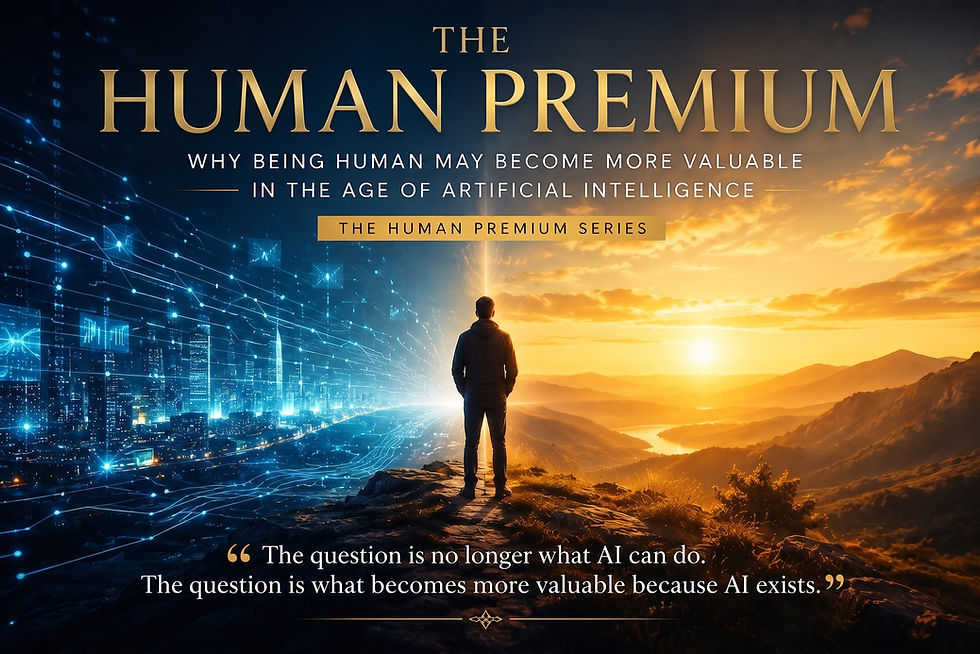
The Human Premium
- Edwin O. Paña

- Jul 18
- 5 min read
Why Being Human May Become More Valuable in the Age of Artificial Intelligence
Artificial intelligence has become one of the defining forces of our time.
It writes, analyzes, designs, translates, diagnoses, predicts, and increasingly performs tasks that once required years of education, training, and experience. With each breakthrough, another boundary between human and machine appears to move.
For many, this progress raises an unsettling question:
What happens when machines can do much of what we once believed made us uniquely intelligent?
It is an important question.
But it may no longer be the most important one.
The question is no longer simply:
What can AI do?
The deeper question has become:
What becomes more valuable because AI exists?
That shift changes the direction of the conversation.
Instead of looking only at the expanding capabilities of machines, we begin to examine the enduring value of humanity itself.
For centuries, knowledge was one of humanity’s greatest advantages. Those who possessed specialized information held influence in government, business, science, education, and industry. Knowledge was scarce, expertise was difficult to acquire, and access often determined opportunity.
The Information Age began to change that.
Artificial intelligence is accelerating the change.
Today, information is abundant. Expertise is increasingly accessible. Analyses that once required teams of specialists can now be generated within seconds.
As intelligence becomes easier to access, something else becomes more valuable.
Wisdom.
AI can produce answers.
It cannot bear responsibility for them.
It can detect patterns.
It cannot fully experience the human consequences hidden within those patterns.
It can generate possibilities.
It cannot decide which possibility is morally right.
It can simulate empathy.
It cannot suffer, forgive, hope, grieve, love, or sacrifice.
These are not minor differences.
They reveal a deeper distinction between computation and consciousness, between processing information and living a human life.
Artificial intelligence may imitate many expressions of intelligence. But intelligence is not the whole of humanity.
Throughout the Hidden Fluency Trilogy, I explored this distinction.
The Gap in the Code asked what remained absent from artificial intelligence despite its remarkable capabilities.
Hidden Fluency proposed that many of humanity’s most important capacities operate beneath the surface of measurable intelligence: wisdom, intuition, moral judgment, empathy, imagination, and the ability to create meaning.
The Eschatology of AI considered what happens when intelligence itself is no longer the defining characteristic that separates humans from machines.
This essay begins a new conversation.
If the trilogy examined the changing meaning of intelligence, this new series explores the changing value of being human.
That value is what I call the Human Premium.
The Human Premium is not the advantage of thinking faster than a machine.
It is not the advantage of storing more information.
It is not the advantage of performing routine tasks more efficiently.
Machines will continue to improve in all three.
The Human Premium lies elsewhere.
It lies in judgment when the facts are incomplete.
It lies in integrity when compromise is easy.
It lies in courage when the outcome is uncertain.
It lies in empathy when another person’s pain cannot be reduced to data.
It lies in imagination when the future has not yet been written.
It lies in the human ability to decide not only what can be done, but what should be done.
This distinction will become increasingly important.
In the workplace, routine cognitive tasks will continue to be automated. But organizations will place a growing premium on people who can inspire trust, navigate ambiguity, build relationships, resolve conflict, and unite others around a shared purpose.
Leadership will become less about possessing all the answers and more about asking the right questions.
The most valuable leaders will not necessarily be those who know the most. They will be those who can exercise judgment, accept responsibility, recognize human consequences, and make difficult decisions without losing their moral centre.
Education will face a similar transformation.
For generations, education has emphasized the acquisition of knowledge. That will remain important, but knowledge alone will no longer be enough.
When students can instantly access information and generate competent answers, education must ask a more demanding question:
Not only, What should students know?
But also, Who should they become?
Character, discernment, curiosity, resilience, creativity, compassion, and moral courage may become as important as technical competence.
The challenge will no longer be simply to produce informed people.
It will be to cultivate wise ones.
This may be one of the great paradoxes of artificial intelligence.
By becoming more capable, machines may force humanity to rediscover the qualities it has too often neglected.
For centuries, we treated speed as progress, efficiency as virtue, and productivity as purpose.
But speed without direction can lead us nowhere.
Efficiency without ethics can magnify harm.
Productivity without meaning can leave human beings empty.
Technology can help us reach a destination faster.
It cannot tell us whether the destination is worth reaching.
That remains a human responsibility.
The Human Premium therefore does not arise from human superiority in every task. It arises from the human obligation to give direction, meaning, and moral purpose to the tools we create.
AI can help us decide how.
Humanity must still decide why.
AI can expand our choices.
Humanity must still decide what is worth choosing.
AI can increase our power.
Humanity must still develop the wisdom to use that power well.
This is why the future will not be shaped by artificial intelligence alone.
It will be shaped by the quality of the human beings who guide it.
The decisive advantage of the future may not belong simply to those who master the most powerful technologies.
It may belong to those who remain trustworthy when deception is easy, thoughtful when speed is rewarded, compassionate when people are reduced to numbers, and principled when power offers shortcuts.
In that sense, the rise of artificial intelligence does not diminish the importance of being human.
It raises the standard.
It asks more of us.
It requires us to move beyond the narrow idea that intelligence is our highest achievement.
Beyond intelligence lies wisdom.
Beyond knowledge lies understanding.
Beyond efficiency lies purpose.
Beyond capability lies responsibility.
And beyond the question of what machines can become lies the more urgent question of what humanity must now choose to become.
That is the Human Premium.
It is not the premium of knowing more.
It is the premium of understanding more deeply.
It is not the premium of thinking faster.
It is the premium of judging wisely.
It is not the premium of competing with machines.
It is the premium of becoming more fully human.
As artificial intelligence continues to transform our world, our greatest advantage may no longer lie in what machines can learn from us.
It may lie in what only humanity can choose to become.
Reflections may be shared beyond this page.


