
The Living Bridge
- Edwin O. Paña

- Mar 6
- 5 min read
Diaspora and the Soft Power of Trust in Canada–Philippines Relations
“Across the Pacific, the strongest bridges between nations are not built of steel or treaties, but of people.”
Trade agreements are often signed in formal rooms between government officials. Shipping routes stretch across oceans, and economic statistics measure the movement of goods, capital, and investment.
Yet the most enduring connections between nations are often built quietly, through people.
Among Canada’s many relationships across the Indo-Pacific, few illustrate this truth more clearly than the partnership between Canada and the Philippines. Beneath the formal architecture of diplomacy and trade lies a powerful human bridge created by one of Canada’s most vibrant and dynamic diaspora communities.
Today, more than one million Canadians trace their heritage to the Philippines. This growing community has become an essential part of Canada’s social fabric, contributing to the country’s healthcare system, entrepreneurship, public service, and cultural life.
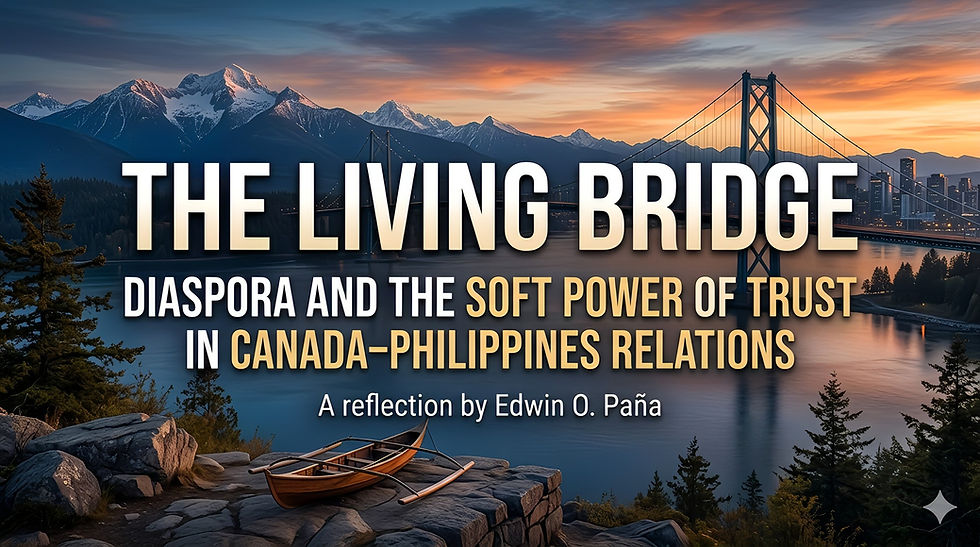
In many ways, the Filipino Canadian community represents a living bridge across the Pacific.
The Diaspora as an Economic Connector
Diaspora communities often play an understated yet vital role in international economic relations. They create channels of understanding that formal institutions alone cannot easily replicate.
Filipino Canadians serve as professionals, entrepreneurs, educators, and community leaders across Canada. Their networks extend naturally across borders, linking families, businesses, and institutions between the two countries.
These connections quietly facilitate economic exchange.
Filipino Canadians are not merely participants in the economy; they are active translators of opportunity. They possess the cultural fluency to navigate the nuances of both Manila’s business environment and Canada’s regulatory landscape. This fluency reduces the friction of entry for Canadian firms and creates pathways for cooperation that formal agreements alone cannot easily produce.
While other nations must build trust from the ground up, Canada and the Philippines begin with a reservoir of goodwill already established in neighborhoods, workplaces, and communities across the country.
In this sense, diaspora communities do more than preserve cultural heritage. They create a competitive advantage grounded in familiarity, credibility, and trust.
Shared Cultural Ground
Another unique feature of the Canada–Philippines relationship lies in its cultural compatibility.
English is widely spoken in the Philippines, and the country has long been connected to global educational systems and legal traditions that align closely with those of many Western democracies. These common reference points make communication and collaboration easier than in many other international contexts.
Another historical layer also contributes to this familiarity. Both Canada and the Philippines are part of the Commonwealth of Nations, a network of countries linked by shared institutional traditions and diplomatic cooperation. While the Commonwealth today does not directly shape trade policy, it has helped cultivate habits of dialogue, governance standards, and educational exchanges that continue to influence relationships among member states.
These institutional parallels quietly reinforce the ease with which Canadians and Filipinos engage one another in professional and civic life.
The relationship is further strengthened by shared cultural values that resonate strongly in both societies: resilience in the face of adversity, a deep commitment to family, and a tradition of hospitality toward others.
In the Philippines, this spirit is captured in the concept of Bayanihan, the communal ethic of helping one another in pursuit of a shared goal. Such values translate naturally into reliable, long-term partnerships that extend beyond contracts and transactions.
The result is a relationship where cultural familiarity often precedes formal agreements.
The Philippines in Southeast Asia’s Growth Story
Beyond its diaspora ties, the Philippines is emerging as an increasingly important partner within Southeast Asia.
The country has a young and expanding population, a dynamic services sector, and a rapidly growing digital economy. As Southeast Asia becomes one of the most significant regions for global economic growth, the Philippines is well positioned to play a central role.
Recognizing this potential, Canada and the Philippines have begun negotiations toward a bilateral free trade agreement aimed at strengthening cooperation across sectors such as agriculture, infrastructure, technology, and services.
For Canada, this represents both an economic opportunity and a natural extension of an already strong human relationship.
The Human Foundations of Trade

In discussions of global trade, it is easy to focus on shipping lanes, tariff schedules, and supply chains. These are important elements of the international economic system.
Yet behind every trade agreement stand human relationships.
Diaspora communities build familiarity between societies. They create trust through shared experiences, family connections, and cultural understanding. These everyday interactions often make economic cooperation smoother and more resilient.
Another dimension of this trust has emerged quietly through what might be described as the care economy.
Filipino Canadians have played an extraordinary role in Canada’s healthcare system, long-term care facilities, and community health services. Their professionalism, compassion, and dedication have earned deep respect across Canadian society.
In many communities, Filipino nurses, caregivers, and healthcare professionals have become indispensable pillars of the country’s care infrastructure.
In this sense, trust between Canada and the Philippines is not built only through trade agreements or diplomatic exchanges. It is also built through everyday acts of care that strengthen the social fabric of the communities they serve.
This quiet contribution represents a powerful form of soft power that rarely appears in trade statistics but profoundly shapes how nations perceive one another.
Soft Power and the Geography of Trust
In an earlier essay exploring Canada’s engagement with the Indo-Pacific, the idea of a “geography of trust” emerged as a guiding concept. Nations increasingly seek reliable partners as global supply chains become more complex and geopolitically sensitive.
Trust, however, does not arise solely from government policy.
It also grows from people-to-people relationships.
If trust is the currency of the evolving global economy, diaspora communities are among the institutions that quietly mint it. Through student exchanges, professional collaboration, cultural engagement, and the everyday bonds of family and community, the Filipino Canadian diaspora continues to strengthen the relationship between Canada and the Philippines.
In the geography of trust, the Filipino Canadian community stands as one of its most reliable landmarks.
They demonstrate that the most resilient connections between nations are not built solely through treaties or shipping routes.
Sometimes the strongest bridges across oceans are built through human kinship.
Data Notes & Sources
This essay draws on publicly available information regarding Canada–Philippines relations, diaspora demographics, and Indo-Pacific economic engagement, including materials from:
• Statistics Canada
• Government of Canada Indo-Pacific Strategy publications
• Global Affairs Canada
• Asia Pacific Foundation of Canada research
• Public information on Canada–Philippines trade and migration trends
The reflections presented interpret these developments through the broader concept of people-to-people diplomacy and diaspora networks.
Explore EP Resource Reflections


